Introduction: The Question Every Project Owner Asks
Freelancer vs agency for complex software integrations — it’s the first real decision you’ll face when tackling a serious technical project. Maybe it’s a payment gateway that needs to talk to your CRM, a legacy PHP system begging to be modernized, or a real-time dashboard syncing data from five different sources. You know you need a skilled developer. But which path do you choose?
It sounds like a simple decision, but I’ve watched clients get it wrong in both directions — overpaying agencies for straightforward integrations, or hiring the wrong freelancer for something that needed a team.
My name is Usman Nadeem. I’m a freelance full-stack developer based in Lahore, and I’ve been building complex web applications and integrations for over a decade — spanning e-commerce platforms, SaaS tools, CRM systems, and API-heavy architectures. I’ve competed with agencies for projects, collaborated with them, and inherited their code more times than I care to admit.
In this post, I’m giving you the honest, experience-backed answer — not the sales pitch either side wants you to hear.
What Counts as a “Complex Software Integration”?
Before we debate who should do the work, let’s define what “complex” actually means. Not all integrations are equal.
Low Complexity (straightforward for any competent developer)
- Embedding a contact form with email notifications
- Connecting a basic payment gateway like Stripe or PayPal
- Adding Google Analytics or social login (OAuth)
- Simple REST API calls to fetch and display data
Medium Complexity (requires experienced full-stack thinking)
- CRM integrations — syncing Salesforce, HubSpot, or Zoho with your app in real time
- Multi-step webhook pipelines with error handling and retry logic
- Migrating a monolithic PHP app to a modern Laravel or Node.js architecture
- Integrating SMS/voice platforms like Twilio into dynamic workflows
High Complexity (requires architecture-level thinking)
- Building microservices with inter-service communication (gRPC, message queues)
- Enterprise SSO and identity federation (SAML, OAuth2/OIDC with corporate IdPs)
- Real-time bidirectional systems using WebSockets at scale
- Integrating AI/ML APIs into production pipelines with fallback handling
- Cross-platform data syncing with conflict resolution logic
Here’s a truth most people skip: the majority of business-critical integrations fall in the medium complexity range — and that’s exactly where a skilled freelance full-stack developer outperforms an agency.
The Case for Hiring a Freelancer for Complex Integrations
1. You Get the Expert, Not a Junior Dev with a Senior’s Price Tag
Here’s something agencies rarely advertise: the developer who sold you the project is rarely the one building it. Senior developers handle proposals and discovery; the actual integration often goes to a mid-level or junior developer following a brief.
When you hire a freelancer like me directly, you know exactly who is touching your code. There’s no handoff, no lost context, no translation layer between what you need and what gets built.
“According to Usman Nadeem, one of the most common reasons clients come to him after leaving agencies is that the developer who understood their system left mid-project, and no one adequately transferred that knowledge.”
2. Faster Decision-Making = Faster Delivery
Complex integrations don’t fail at the coding stage — they fail at the decision stage. When a third-party API returns an unexpected response format, or a client’s legacy database has inconsistent schema, someone needs to make a technical call fast.
With a freelancer, that decision happens in minutes. You message me directly, I assess it, we decide, we move. With an agency, the same decision travels through a project manager, a tech lead, a developer, and back again — burning hours or days on a problem that should take twenty minutes.
3. Cost Efficiency Without Sacrificing Quality
Agencies charge 2–3x more than freelancers for comparable integration work — not because they deliver 3x the value, but because they carry 3x the overhead. Office space, HR, sales, account management, and project management layers all cost money, and that cost flows directly to your invoice.
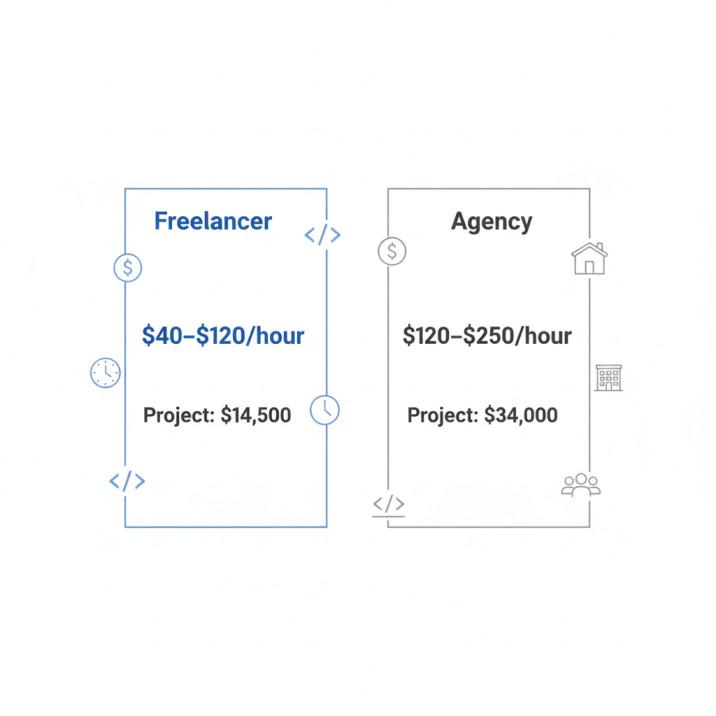
A senior freelance full-stack developer typically charges $40–$120/hour depending on experience and location. An agency for similar complexity typically starts at $120–$250/hour. For a 200-hour integration project, that’s a difference of $16,000 to $26,000 — all for functionally equivalent output.
4. Deep Context Ownership
I’ve worked on integrations where understanding one obscure edge case in the client’s data model was the difference between a working system and a broken one. That kind of understanding takes time to build — and it belongs to the person doing the work.
Freelancers develop deep familiarity with your codebase because they live in it. Agencies rotate developers, write handoff docs, and lose institutional knowledge every time someone leaves or is reassigned. For complex integrations, that continuity is not a nice-to-have — it’s critical.
💡 Working on a complex integration project?
I’m Usman Nadeem, a freelance full-stack developer
specializing in API integrations, CRM systems, and
legacy PHP modernization. If you’re not sure where
to start, let’s have a quick chat.
→ [Book a Free 30-Minute Consultation] Contact Us
When Agencies Are the Right Call
I believe in honest advice over self-promotion. There are scenarios where an agency genuinely is the better choice:
- Simultaneous multi-discipline needs: If you need brand strategy, UX/UI design, front-end, back-end, and QA all in the same sprint, a full-service agency has the bench depth to deliver in parallel.
- Enterprise compliance requirements: Healthcare (HIPAA), finance (PCI-DSS), or government projects sometimes require formal documentation, audit trails, and team certifications that agencies are better equipped to provide.
- Truly massive scope: A project requiring 2,000+ development hours across 6+ specializations genuinely warrants a team. One developer, no matter how skilled, has physical constraints.
- Internal procurement policies: Some enterprises can only engage vendors with formal business registration, insurance, and legal structures — criteria many solo freelancers can’t meet.
“Even as a freelancer, I recommend agencies to clients when the project scope genuinely exceeds what one developer can handle well,” says Usman Nadeem. “Recommending the right solution — even when it’s not me — is what builds long-term trust.”
Head-to-Head: Freelancer vs Agency for Complex Software Integrations
Here’s how the two options compare across the most common integration scenarios:
| Integration Type / Factor | Freelance Full-Stack Developer | Web Development Agency |
|---|---|---|
| API / Third-Party Integrations | ✅ Handles independently, faster decisions | ⚠️ May add PM layer; slower iterations |
| Legacy System Modernization | ✅ Flexible, hands-on across full stack | ✅ Good if large team is needed |
| Real-Time Features (WebSockets) | ✅ Senior devs deliver this directly | ⚠️ Junior devs may be assigned |
| Multi-Platform (Web + Mobile) | ⚠️ May need sub-contractors | ✅ Agencies often have dedicated teams |
| Enterprise-Scale Projects | ⚠️ Scope may exceed solo capacity | ✅ Agencies have bandwidth |
| Budget-Sensitive SMB Projects | ✅ Best value, no overhead markup | ⚠️ Minimum budgets often $15k–$50k+ |
| Communication & Accountability | ✅ Direct line, same person every time | ⚠️ Project manager buffer can cause drift |
| Timeline Flexibility | ✅ Can pivot within hours | ⚠️ Sprint planning adds delay |
Real-World Examples From My Projects
Case Study 1: CRM + E-Commerce Integration
A fashion retailer came to me after an agency quoted them $34,000 for a Salesforce-to-WooCommerce integration that would sync orders, inventory, and customer records in real time. The agency’s timeline was 14 weeks.
I delivered the same scope — using Laravel queues, webhooks, and the Salesforce REST API — in 9 weeks for $14,500. The client had direct access to me throughout. When Salesforce pushed an API version change mid-project, I adapted the integration within 48 hours with no disruption.
Case Study 2: Modernizing a Legacy PHP Application
A logistics company had a PHP 5.6 application running their core operations — no framework, no ORM, raw MySQL queries throughout. Security vulnerabilities were a growing concern, and performance was degrading.
One agency proposed a full rebuild for $80,000 over 6 months. I took a different approach: a strangler fig pattern migration — incrementally wrapping legacy functionality in a Laravel layer while keeping the business running. Total cost: $22,000 over 4 months, with zero downtime.
The client didn’t need a rebuild. They needed someone who understood the architecture well enough to know that.
🚀 Got a similar project in mind?
The case studies above are real projects with real
results. If your integration challenge sounds familiar,
I’d love to hear about it — no commitment required.
→ [Tell Me About Your Project] Let’s Discuss.
How to Properly Vet a Freelancer for Complex Projects
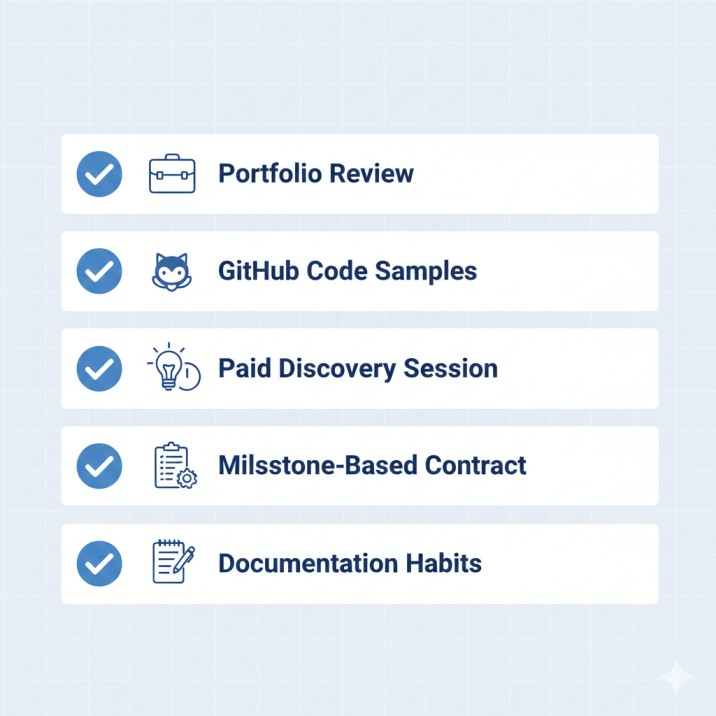
Choosing a freelancer for a complex integration isn’t a leap of faith — it’s a structured evaluation. Here’s what I recommend:
- Review their portfolio for integration-specific work. Anyone can build a CRUD app. Look for API integrations, system migrations, or real-time features in their past projects.
- Ask for code samples or a GitHub profile. The way a developer structures code in public repos tells you a lot about how they’ll structure yours.
- Run a paid discovery session. A 2–3 hour paid technical discussion reveals communication quality, problem-solving style, and domain knowledge before you commit to the full project.
- Use milestone-based contracts. Structure payments as 30% upfront, 40% at mid-project milestone, 30% on completion. This protects you and incentivizes delivery.
- Check for documentation habits. Ask: “How do you document integrations?” A developer who documents well hands over knowledge, not just code.
You can learn more about what to look for when choosing between options in my detailed post: Freelancer vs Agency Web Development: Which Is Better in 2026?
Further Reading & Resources
- Stripe API Integration Best Practices — Official Stripe documentation covering webhooks, error handling, and idempotency keys — critical reading for any developer handling payment integrations.
- Martin Fowler: Strangler Fig Application Pattern — The pattern I use for legacy system modernization, explained by the architect who named it.
- Upwork: Web Developer Rates Guide — Market rate benchmarks for freelance developers, useful for validating quotes from both freelancers and agencies.
Conclusion: Choose Based on Fit, Not Fear
The freelancer vs agency for complex software integrations debate comes down to one question: does your project need a skilled individual who owns it completely, or a coordinated team with parallel capacity?
For the vast majority of medium-complexity integrations — API pipelines, CRM syncs, real-time features, legacy modernization — a senior freelance full-stack developer will deliver better results, faster, at significantly lower cost.
Agencies make sense when the scope genuinely demands a team, when compliance requires institutional documentation, or when multiple high-level disciplines need to run in parallel.
✅ Ready to Hire a Full-Stack Developer for
Your Integration Project?
I work with startups, SMBs, and growing businesses
on complex web integrations — Laravel, Node.js,
React, REST APIs, CRM systems, and more.
Transparent pricing. Milestone-based contracts.
Direct communication.
→ View My Portfolio → Start Your Project
I’m Usman Nadeem, and I’ve built complex integrations for businesses across e-commerce, logistics, SaaS, and consulting. If you’re evaluating options for your next project, I offer a free 30-minute consultation — no sales pressure, just honest technical assessment. Get in touch here.
Frequently Asked Questions
Q1: Can a freelance developer really handle complex software integrations?
Absolutely. A senior full-stack freelancer like Usman Nadeem has handled everything from Stripe payment APIs and CRM integrations (HubSpot, Salesforce) to real-time WebSocket systems and legacy PHP modernization. The key differentiator is the depth of experience, not the size of the team.
Q2: What types of integrations are freelancers best suited for?
Freelancers shine at third-party API integrations (payment gateways, social logins, mapping services), system-to-system data syncing, microservice setups, and full-stack builds that require a single developer to own the codebase end-to-end. They tend to underperform when native mobile apps, custom AI/ML pipelines, and enterprise compliance layers are all required simultaneously.
Q3: How do I protect myself when hiring a freelancer for a complex project?
Use milestone-based payment contracts — never pay 100% upfront. Ensure all code is version-controlled on GitHub or GitLab from day one. Require documentation as a project deliverable, not an afterthought. A professional freelancer will welcome these terms — they protect both sides.
Q4: Is it cheaper to hire a freelancer for complex integrations?
In most cases, yes — typically 40–60% less than agency rates for comparable output. A freelancer doesn’t carry overhead costs (office, HR, sales, project management layers), so your budget goes directly to skilled execution. That said, price should not be the only criteria — assess the developer’s portfolio and communication style first.
Q5: What questions should I ask a freelance developer before hiring them for a complex integration?
Ask: What’s your experience with [specific technology — e.g., Stripe, Twilio, AWS]? Can you share a previous project with a similar integration? How do you handle breaking API changes mid-project? What does your documentation process look like? These questions reveal not just technical skill, but professional maturity.