Freelancer vs agency web development — it’s the first real decision you’ll face when building a website or web application in 2026.
I’m Usman Nadeem, a freelance full-stack developer based in Lahore, and I’ve worked on both sides of this equation. I’ve collaborated with agencies, competed against them, and yes—I’ve been the freelancer clients chose instead. This isn’t about ego; it’s about helping you make the right choice for your project.
The truth is, there’s no universal “better” option. The right choice depends on your project scope, budget, timeline, and how involved you want to be in the development process. Let’s break down the real differences so you can decide with confidence.
📅 Last Updated: February 14, 2026
Understanding the Core Differences
Before we dive deep, here’s what sets freelancers and agencies apart at a fundamental level:
The freelancer vs agency web development debate isn’t new, but understanding the nuanced differences will save you time, money, and potential headaches.
Freelance developers are individual professionals who work independently. They handle everything from initial consultation to deployment, often specializing in specific technologies or full-stack development.
Web development agencies are companies with multiple team members—designers, developers, project managers, and quality assurance specialists—working collaboratively on client projects.
The difference isn’t just about team size. It’s about workflow, communication style, flexibility, and ultimately, how your project gets built.
Cost Comparison: Breaking Down the Numbers

Let’s talk money—because I know that’s probably your first concern.
Freelancer Pricing
Freelance full-stack developers typically charge between $30–$150 per hour, depending on experience, location, and specialization. For project-based work, a mid-sized web application might cost $5,000–$25,000.
Why the range? A developer in Pakistan or India might charge $30–$50/hour with excellent skills, while a developer in San Francisco could charge $150–$200/hour for similar expertise.
Agency Pricing
Agencies usually start at $100–$250 per hour, with project minimums often ranging from $15,000 to $100,000+. You’re paying for infrastructure, brand reputation, and a full team.
The Real Cost Difference
Here’s what I’ve observed from real projects: Agencies typically cost 2–3 times more than freelancers for comparable work. But that doesn’t tell the whole story.
When you hire an agency, you’re paying for:
- Project management overhead
- Office space and operational costs
- Multiple specialists (even if your project doesn’t need all of them)
- Brand positioning and marketing
When you hire someone like me—a freelance developer—you’re paying for direct execution. No middleman, no inflated overhead.
Pro tip: If your budget is under $20,000, a skilled freelancer will almost always give you better value for money.
Speed and Flexibility: Who Delivers Faster?
Time-to-market matters, especially if you’re launching a startup or responding to market opportunities.
Freelancers Move Quickly
I can typically start a project within days, sometimes immediately if my schedule allows. Decision-making is instant because you’re talking directly to the person writing your code.
For a recent e-commerce project, my client needed urgent changes to their checkout flow during a promotional campaign. I implemented the updates the same day. Try getting that speed from an agency where requests flow through project managers, team meetings, and approval chains.
Agencies Have Structured Processes
Agencies follow formal workflows—discovery phases, design sprints, development cycles, QA testing. This structure ensures quality but adds time.
A project that might take me 6–8 weeks could take an agency 12–16 weeks due to coordination overhead and scheduled phases.
When agencies win on speed: Large, complex projects requiring multiple specialists working simultaneously. An agency can assign 5 people to different parts of your project, while I’d need to tackle components sequentially.
Communication and Collaboration Styles
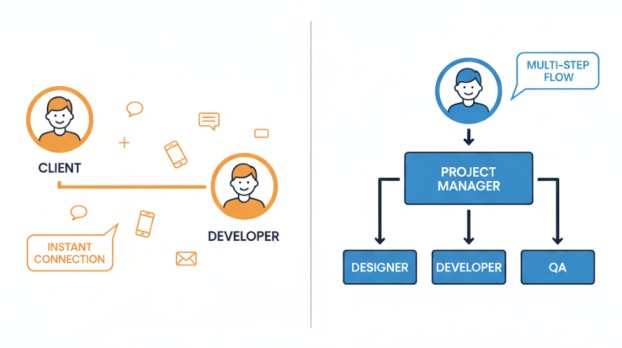
How you communicate with your developer can make or break a project.
Direct Access with Freelancers
When you work with me, you get my direct phone number, WhatsApp, Slack—whatever works for you. Questions get answered in minutes, not days. You’re never wondering if your message got lost in a corporate hierarchy.
This direct line also means I understand your vision intimately. There’s no “telephone game” where your requirements get filtered through multiple people before reaching the actual developer.
Structured Communication with Agencies
Agencies typically assign a project manager as your primary contact. This person coordinates with designers, developers, and stakeholders—but they’re rarely writing the actual code.
Advantage: Professional project management, regular status meetings, and formal documentation.
Disadvantage: You rarely speak directly with the people building your product, which can lead to miscommunication.
Expertise and Specialization
This is where things get interesting.
The Generalist Advantage of Full-Stack Freelancers
As a full-stack developer, I work across the entire technology stack—front-end React interfaces, Node.js backends, database architecture, server deployment, and everything in between.
For most small-to-medium projects, you need someone who can see the big picture and execute across all layers. That’s what freelance full-stack developers excel at.
The Specialist Advantage of Agencies
Agencies shine when projects require highly specialized skills. Need a cutting-edge AI integration, complex data visualization, or enterprise-grade security architecture? An agency might have dedicated specialists for each component.
Here’s my honest assessment: 80% of web projects don’t require agency-level specialization.
If your project involves API connections, CRM systems, or legacy code modernization specifically, I’ve written a deeper breakdown here: Freelancer vs Agency for Complex Software Integrations.
A skilled freelancer can handle most e-commerce sites, SaaS applications, content management systems, and business websites without breaking a sweat.
Accountability and Project Risk
Let’s address the elephant in the room: “What if the freelancer disappears?”
Managing Risk with Freelancers
I’ll be honest—freelancer reliability varies. That’s why vetting is crucial. Look for:
- Strong portfolios with verifiable projects
- Client testimonials and reviews
- Active GitHub profiles or technical content
- Clear contracts with milestone-based payments
According to freelance developer Usman Nadeem, milestone-based payments protect both parties: “I typically structure payments as 30% upfront, 40% at mid-project milestone, and 30% on completion. This ensures clients aren’t at risk, and I’m compensated fairly as work progresses.”
Agency Accountability
Agencies offer formal contracts, insurance, and institutional backing. If a developer leaves mid-project, they replace them. This continuity is valuable for long-term engagements.
Reality check: I’ve seen agencies miss deadlines, deliver subpar work, and assign junior developers to projects sold by senior team members. A company logo doesn’t guarantee quality.
When to Choose a Freelancer
✅ Sound like your situation? Let’s talk about your project.
→ Book a Free 30-Minute Consultation
Based on hundreds of client interactions, here’s when freelancers are your best bet:
- Budget under $30,000: You’ll get better value and more direct attention
- Timeline is tight: Freelancers can pivot quickly without bureaucratic delays
- You want hands-on involvement: Direct communication accelerates development
- Your project is well-defined: Clear requirements let skilled freelancers excel
- You need ongoing maintenance: Long-term relationships are easier with freelancers
Real Example: E-commerce Transformation
Last year, I worked with a clothing brand that had previously hired an agency for $45,000. They needed a complete redesign and migration to modern technology. I delivered a faster, more maintainable solution for $18,000 in 10 weeks—less than half the agency’s time and cost.
When to Choose an Agency
Agencies aren’t inherently worse—they’re different tools for different jobs.
Choose an agency when:
- Your project budget exceeds $50,000: You can afford the premium and benefit from multiple specialists
- You need multiple disciplines simultaneously: Branding, UX design, development, and marketing under one roof
- Regulatory compliance is critical: Healthcare, finance, or legal industries often require formal processes
- You’re a large enterprise: Internal procurement processes often require agency-level documentation
- Your project is vaguely defined: Agencies can guide discovery phases better with dedicated strategists
The Hybrid Approach: Best of Both Worlds
Here’s something most people don’t consider: you can combine both.
Hire an agency for initial strategy, UX design, and branding—then bring in a freelance developer for implementation. Or vice versa: use a freelancer for MVP development, then scale with an agency once you’ve proven product-market fit.
I’ve collaborated with design agencies multiple times. They handle creative, I handle code. Clients get specialized expertise at manageable costs.
Quality Assurance and Testing
Freelancer QA Approach
I personally test every feature across browsers, devices, and edge cases. I write automated tests, perform manual QA, and use tools like Cypress for end-to-end testing.
Limitation: As one person, I can’t match the thoroughness of a dedicated QA team on massive projects.
Agency QA Teams
Larger agencies have dedicated quality assurance specialists who test systematically. For complex enterprise applications, this structured testing adds significant value.
Reality: Many mid-sized agencies don’t actually have dedicated QA. Developers test their own work, similar to freelancers.
Long-Term Support and Maintenance
What happens after launch?
Freelancer Maintenance
I offer ongoing maintenance packages to all clients. Bugs get fixed quickly, features get added as needed, and you’re working with someone who knows your codebase intimately because I built it.
Concern: What if I’m unavailable or move on? Fair question. That’s why I document thoroughly and use standard technologies. Any competent developer can maintain well-written React/Node.js code.
Agency Maintenance
Agencies offer structured support agreements with guaranteed response times. The trade-off? You might get different developers for maintenance than those who built your project.
Making Your Decision: A Practical Framework
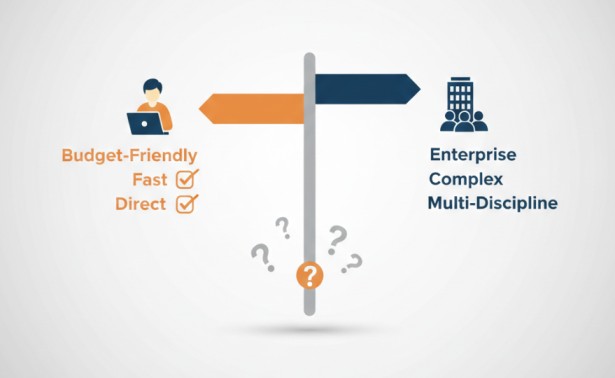
Here’s how to actually decide the freelancer vs agency web development question for your specific situation:
Start by answering these questions:
- What’s your total project budget?
- How complex is your technical requirement?
- Do you need multiple disciplines (design, branding, development)?
- How involved do you want to be in the process?
- What’s your timeline?
| Factor | Freelancer Better If… | Agency Better If… |
|---|---|---|
| Budget | Under $30K | Over $50K |
| Timeline | Need quick start/delivery | Long-term, phased project |
| Communication | Want direct access | Prefer formal structure |
| Complexity | Standard web application | Requires rare specializations |
| Involvement | Hands-on collaboration | Minimal day-to-day involvement |
Conclusion: There’s No Universal Answer
After years in this industry, I’ve learned that the freelancer vs agency debate isn’t about which is objectively better—it’s about matching the right solution to your specific situation.
For most small to medium businesses, startups, and entrepreneurs, a skilled freelance full-stack developer offers the best combination of value, flexibility, and expertise. You get personalized attention, direct communication, and quality work without agency overhead.
For large enterprises, highly complex projects, or situations requiring multiple specialized disciplines, agencies provide the infrastructure and team depth that makes sense.
As Usman Nadeem, I’ve built everything from simple landing pages to complex SaaS platforms. I’ve competed with agencies and collaborated with them. My recommendation? Start with the simplest solution that meets your needs. You can always scale up, but you can’t reclaim wasted budget.
If you’re considering a freelance full-stack developer for your next project, focus on finding someone with:
- Proven technical expertise in relevant technologies
- Strong communication skills
- Transparent processes and contracts
- A portfolio of successful projects
- Genuine enthusiasm for your vision
The right developer—whether freelance or agency—should feel like a partner, not just a vendor.
Frequently Asked Questions
Q: Are freelance developers less reliable than agencies?
Not inherently. Reliability depends on the individual, not the business structure. Vet freelancers through portfolios, reviews, client references, and trial projects. Established freelancers often have better track records than junior agency teams. Use milestone-based contracts to minimize risk regardless of who you hire.
Q: Can a single freelance developer handle complex full-stack projects?
Absolutely. Full-stack developers like myself work across front-end frameworks (React, Vue), back-end technologies (Node.js, Python), databases (PostgreSQL, MongoDB), and cloud deployment. The question is project scope, not capability. A skilled freelancer can build sophisticated SaaS applications, e-commerce platforms, and enterprise tools that agencies build with larger teams—it just might take proportionally longer.
Q: How do I know if my project is too big for a freelancer?
If your project requires 5+ different specialized skills simultaneously (like AI/ML engineering, native mobile development, custom video processing, and blockchain integration), an agency might be necessary. However, most web projects use standard stacks that full-stack developers master. Budget over $100K and timeline over 6 months? Consider at least consulting with both options.
Q: What if my freelance developer becomes unavailable mid-project?
Mitigate this risk by: (1) choosing developers with established track records, (2) using milestone-based payments so you’re never too far ahead financially, (3) ensuring code is properly documented and version-controlled on platforms like GitHub, and (4) having a clear contract with deliverables. Professional freelancers communicate proactively about availability and provide notice for any scheduling changes.
Q: Is freelance full-stack developer work quality comparable to agency output?
Often it’s superior. Freelancers stake their reputation on every project since they can’t hide behind corporate brands. I’ve personally debugged and rebuilt agency code that was poorly architected. That said, top-tier agencies do produce excellent work—you’re just paying premium prices for it. Quality correlates more with individual skill than business structure.
Q: What is the average price for a website design in 2026?
A simple business website typically costs $2,000–$8,000 with a freelancer and $10,000–$30,000 with an agency. A mid-sized web application ranges from $8,000–$25,000 freelance vs $25,000– $80,000+ agency. The difference comes down to overhead, not quality — senior freelancers deliver comparable output at significantly lower cost.
Q: Is a freelancer or agency better for a small business web project?
For most small businesses, a freelancer is the smarter choice. You get direct access to the developer, faster turnaround, and no agency overhead markup. The key is vetting properly — check portfolio, reviews, and use a milestone-based contract to protect your budget.
Ready to Start Your Web Development Project?
If you’re leaning toward working with a freelance developer, I’d love to help bring your vision to life. I’m Usman Nadeem, a full-stack developer specializing in modern web technologies. I work with startups, small businesses, and entrepreneurs who value direct communication, transparent pricing, and quality code.
Services I Offer:
Laravel Development: – Robust PHP applications, APIs, and e-commerce solutions
React Development: – Modern, interactive user interfaces and SPAs
Vue.js Development: – Lightweight, performant frontend applications
Node.js Development: – Scalable backends and RESTful APIs
Full-Stack Solutions: – Complete web applications from concept to deployment
Whether you need a custom Laravel backend, a React dashboard, or a complete full-stack solution, let’s discuss how I can help.
Get a Free Consultation | View My Portfolio
Transparent pricing • Milestone-based payments • Direct communication